


Go Wild
In Madagascar — where 100+ varieties of lemurs leap and 800-year-old baobab trees tower — travelers find an island on which 90% of its species exist nowhere else in the world. But you’re probably not getting there on your own. That’s where Anne (Milmoe) ’97 Avellana comes in.
In her work with Natural Habitat Adventures, Anne (Milmoe) ’97 Avellana has traveled to Tsingy de Namoroka National Park in Madagascar (above left; photo by Ludovic Ravaohery) and Hwange National Park in Zimbabwe (above right).
She’s a senior adventure director at Natural Habitat Adventures, a travel company that offers wilderness experiences like swimming with sea lions in the Galápagos, photographing pumas in Patagonia, and encountering orangutans in Borneo.
The organization curates small-group trips with an eco-conscious focus, from the travel logistics to the educational opportunities to its relationships with host countries. “The fact that Natural Habitat Adventures believes that travel plays a crucial role in protecting the planet and that conservation and exploration go hand in hand is certainly one of the main reasons why I work there,” Avellana says.
From her office in Boulder, Colo., she currently specializes in designing trips to southern Africa — Madagascar, Zambia, and Zimbabwe — where the high season is during the U.S. summer because it’s wintertime in Africa.
 Avellana plans every detail, from the sites to the guides to the hotels and meals, keeping sustainability in mind for everything. “For instance, if I need to charter a plane to bring a group of travelers to their destination, I strategically schedule the trip dates so that the same plane can bring a different group of travelers back,” she explains, adding that the company offsets the emissions of all flights. (Natural Habitat Adventures calls itself “the world’s first 100% carbon-neutral travel company.”) Nearly all of the guides are locals, and the partnering hotels and organizations must share an eco-friendly ethos. Avellana is even mindful of the nitty-gritty: “I spend a lot of time looking for ways to reduce waste by making sure we have things like cloth napkins and reusable water bottles on our trips.”
The larger mission is to educate travelers and boost economies in the host countries in order to preserve natural resources. “By having people travel, we’re lifting up all of these communities, and indeed, countries,” Avellana says. “In Madagascar, most of the forests have been destroyed through slash and burn agriculture. The areas that are protected have amazing biodiversity. We want to work with locals to realize that trees are more valuable up than down because of the tourism dollars these areas bring in.”
Natural Habitat Adventures is a partner of the World Wildlife Fund and, as such, works with scientists and experts to inform its travelers through lectures. Many who take these trips are Americans, Avellana says, and “[when we] bring people to see these special places, they’re going to get invested in them. A lot of the people who travel with us are very influential and can help shape policy and, hopefully, leave the planet a little bit better.”
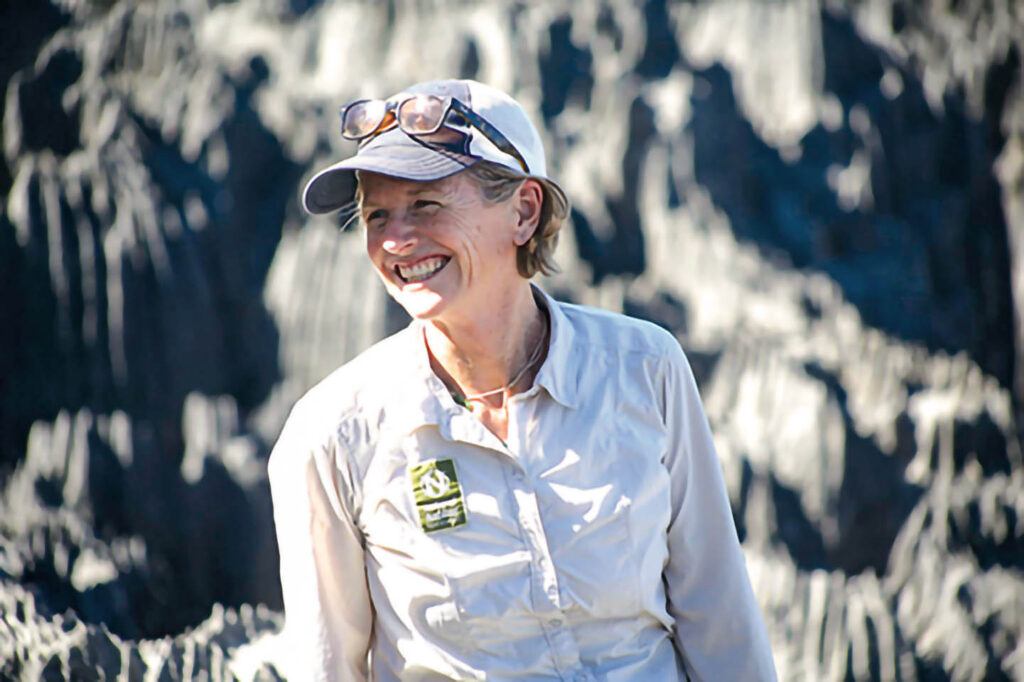 When Avellana tells people about her job, it’s a common misconception that she’s always on vacation, but she does travel once a year to scout her locations. At press time, she was preparing for two weeks in Madagascar to do recon for a new trip she’s planning. Her checklist included visiting different camps, interviewing guides and drivers, and talking to restaurants about meeting dietary restrictions — “making sure people’s basic needs are taken care of is a lot of what I help set up ahead of time.”
Back in Boulder, every few weeks, Avellana takes the emergency phone shift, assisting travelers and trip partners anywhere at any time, with situations like missed flights or itinerary pivots due to weather.
In her 12 years with Natural Habitat Adventures, Avellana has specialized in different locations. She spent a decade managing trips to see polar bears in Manitoba and grizzly bears in Alaska. The latter is one of her personal favorite travel experiences, in Katmai National Park, where the bears haven’t been threatened by humans “so they just don’t care about us, and you can be a couple meters away,” she says. “Being on the ground with such an apex predator in a very safe way is a thrilling experience,” she says. “It does not compare to anything else I’ve seen.”
Avellana doesn’t call herself a thrill seeker; rather she seeks outdoor experiences — in skiing, hiking, and kayaking — and enjoys helping make Earth’s wonders more accessible to travelers. “There are lots of ways to go on summer vacation, and I’m proud to design and operate trips like these for people who are interested in the natural world.”

Selling Ice Cream Dreams
You’ve likely seen freeze-dried ice cream for astronauts. Game changer: What if they could make fresh soft-serve on the Moon? That’s a professional goal of Paul Toscano ’07, senior director of sales at ColdSnap, which sells single-serve frozen-treat machines and mixes.
Toscano recently sold the products to NASA’s Jet Propulsion Laboratory (JPL), and on his visit to the Pasadena, Calif., site, his contact wondered aloud: Could they put a machine on the Moon base? “I’d love to work on that project with you,” Toscano replied.
The Long Island–based salesman had another unexpected experience recently, when the Archdiocese of Newark (NJ) was purchasing two machines for its cafeteria. The deal was delayed due to the momentous passing of Pope Francis. “I never thought the Pope would be affecting my workflow,” Toscano says.
Organizations like the JPL and Archdiocese of Newark — along with universities, stadium boxes, golf courses, and car dealerships — are the types of clients to which Toscano caters. There are a few hundred private residences that have the ColdSnap machine, but its main customer profile centers around group gathering places.
 Here’s how Toscano built his career scoop by scoop:
A psychology major, he still uses the skills he learned at Colgate today. “Being in sales, I deal directly with people, and seeing things from their perspective is really important in developing meaningful relationships. I credit my time at Colgate for developing my understanding of how people think, react, and operate.” He also still keeps in touch with Doug Johnson, the William R. Kenan Jr. Professor of psychological and brain sciences. Toscano went on the Wollongong, Australia, study-abroad trip with him and says, “He’s one of my favorite professors of all time.”
With a film and media studies minor, Toscano got his first job as an associate producer at NBC and was soon promoted to producer at CNBC. At the same time, he earned his MBA at New York University: “I always wanted to do something creative, and business school taught me that being creative in a business sense can be really interesting.”
At CNBC, he started producing stories “about cool companies,” and covered a coffee company called Joyride. He couldn’t stop thinking about the concept (cold brew coffee on tap), met with the founders several times to learn about their growth plan, and signed on as its COO in 2013. He helped expand Joyride to a $30 million business, but when the pandemic hit, the company was acquired by Aramark Refreshments. “I knew that I really wanted to stay in high-end food,” Toscano says.
He spent three years at Aramark Refreshments before becoming wowed by ColdSnap in 2023. “This is going to go somewhere,” he remembers thinking. “We get to change the landscape in ice cream.” The machine was imagined by the founder and his two daughters who wanted to figure out how to make an easy-to-use, single-serve ice cream machine. The product is approximately the size of an espresso machine and works by inserting a small can, which is shelf stable and thus has a lower carbon footprint.
Of the handful of flavors of ice cream (there are also nondairy options, protein shakes, a fruit smoothie, and two coffees), Toscano has a hard time choosing his favorite: “boozy bourbon … salted caramel … Mexican hot chocolate, final answer.”
From the Moon to a Connecticut golf course that wants to install a machine on a golf cart, Toscano’s sales are serving up fun. “I feel very lucky because I get to travel around the country talking about ice cream. It’s awesome.”
Taking the Sweat Out of Pickleball
Wendi Green ’98 Aspes became obsessed with pickleball the way many people did: She was at home during the pandemic looking for something to do when she decided to give it a try.
“I ordered a net and some starter paddles and set it up in the driveway, and the whole family just started playing,” says Aspes, an avid tennis player who lives in Atlanta. “And I realized this is a lot more fun than I thought.”
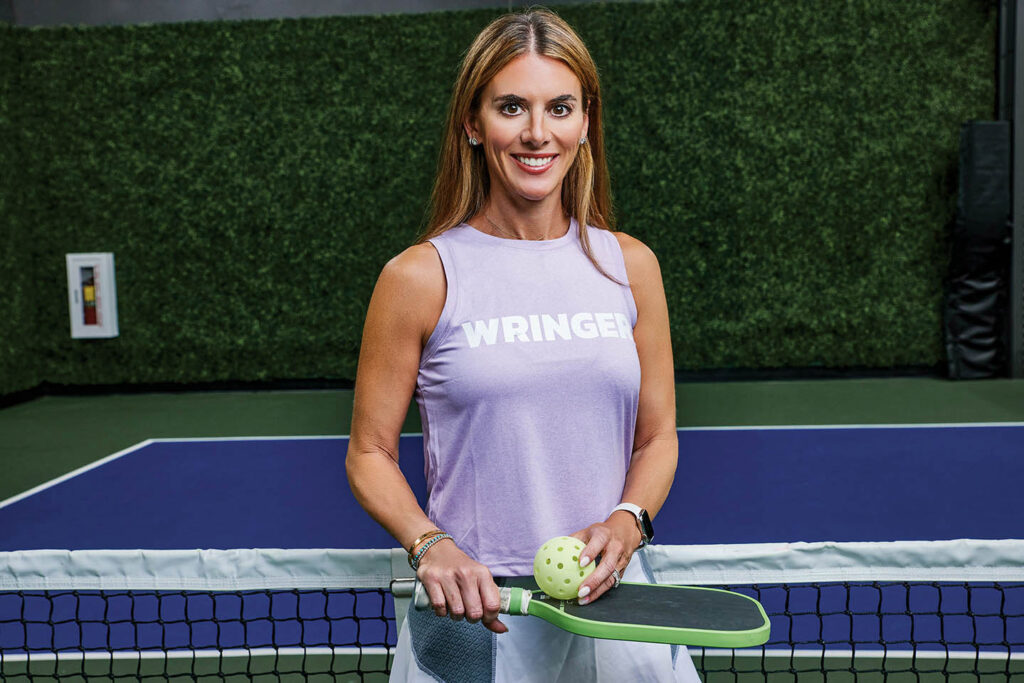
While playing with her brother-in-law, Aspes noticed that they were both wiping the sweat off their hands on their clothes. A fast-paced mashup of badminton and ping pong, pickleball involves constant movement, which can lead to excessive sweating. To deal with this problem, Aspes turned to gels, powders, sweat bands, and towels before coming up with a better solution: Designing clothing that would absorb sweat.
Aspes uses a patented technology called DRYV, a two-layer fabric that wicks moisture away from the body while acting as a towel to absorb sweat. After spending months creating a line of sports apparel incorporating this fabric, Aspes and her brother-in-law, Jason, launched Wringer Wear in March 2025.

“When you talk to any player, whether it’s pickleball, paddle tennis, ping pong, racquetball, or squash, and you say, ‘Do your hands sweat when you play?’ — every single one across the board says ‘yes’ because you’re holding a paddle or racket tightly,” Aspes says. “So we’re a solution for a problem that racket sports enthusiasts have. You can wipe your hands directly on your gear and it will absorb the sweat.”
Wringer Wear is available online, at selected clubs across the country, and at pickleball tournaments nationwide. The line includes everything from shirts to sweatshirts to hats; prices range from $35 to $95.
Creating a sports apparel business is what Aspes calls her “second act,” following a 10-year career working in the nonprofit world — most recently as marketing director for Ian’s Friends Foundation for pediatric brain cancer research.
While she is now a board member, Aspes left her position at the foundation in March so she could focus on her new start-up. Her work on the venture had begun in 2021 when she partnered with a California-based manufacturing company to bring her idea to life.
“Pickleball is the fastest-growing sport in the country, and Wringer was built for those who love the community and the competitive aspects of the game,” Aspes says. Statistics bear out that claim: For the past four years, participation in pickleball has increased more than the growth in any other sport, according to the Sports and Fitness Industry Association.
Aspes hopes that Wringer Wear will give players a competitive edge in their game because it will allow them to focus on their next point instead of their sweaty hands.
So far, the reaction to the line from pickleball players Aspes has met at tournaments has been positive. “People are really excited,” she says. “They see it as a solution.”
The demand for the apparel is likely to increase as pickleball continues to grow in popularity because of its appeal to all age groups and the sense of community it offers, Aspes says.
“We live in a divisive world, and not that pickleball is going to solve any of our world problems, but it brings people together,
and you feel like you’re part of something,” she says.
— Sherrie Negrea
A Breath of Fresh Air for City Kids
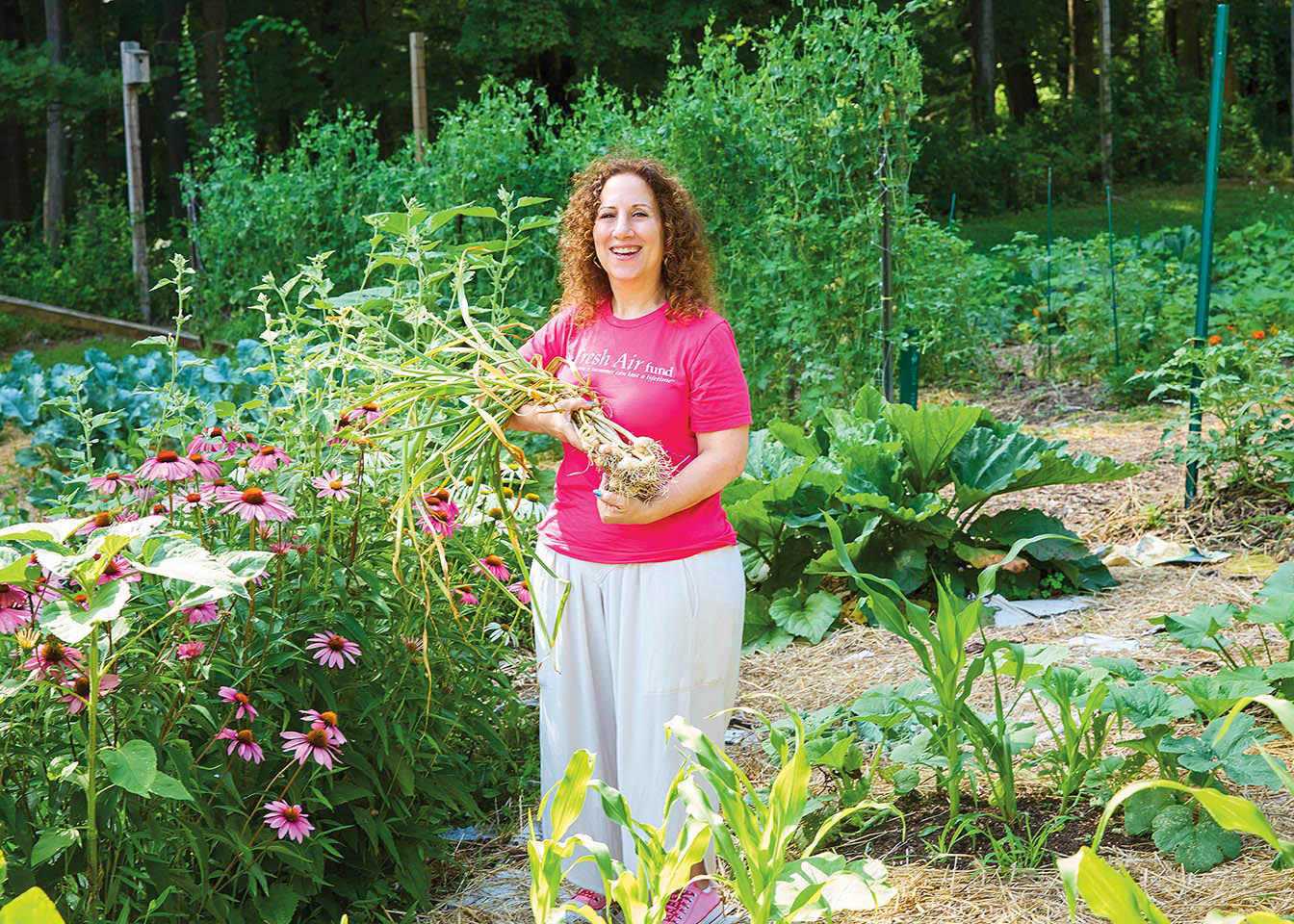
Several times a week, Lisa Gitelson ’91 leaves her office in midtown Manhattan and drives two hours north to Sharpe Reservation in Fishkill, N.Y., where she’ll visit one of the Fresh Air Fund camps and its Model Farm. The farm cultivates more than just rhubarb and strawberries; New York City children learn about plant care, eating healthy, and tending to animals. This is in addition to traditional camp activities like swimming, boating, and arts and crafts.
Lisa Gitelson ’91; photos courtesy of Fresh Air Fund
Five of the Fresh Air Fund’s six sleepover camps are on Sharpe Reservation, and as CEO of the youth development organization — which provides outdoor experiences, at no cost, to New York City children from underserved communities — Gitelson goes to support the staff, connect with campers, and give tours to potential donors.
“At the end of the day, I’m in charge of making sure that this work happens,” Gitelson says to describe her job in a nutshell. She just completed a new strategic plan for the organization and oversees all operations, including fundraising, staff, and communications.
This role, which she began in 2022, is the latest in Gitelson’s career of advocating for children. She spent numerous years as an attorney specializing in foster care and family court cases. Then in 2012, she accepted a position as director of foster care and adoption at the family services nonprofit Sheltering Arms, after serving as its in-house counsel. This new role “was something I’d always been extraordinarily interested in doing. I moved into big-picture work and impact work; it felt like a natural progression of what I hoped to do,” she says.
Gitelson, who grew up in Croton on Hudson, N.Y., “loved the outdoors”; she went to summer camp as a kid and became a counselor as a teenager. Her two children — who are now 20 and 24 — also went to camp and have an appreciation for nature, even though she raised them in the city.
“One of my kids will call and say, ‘I’m having a really hard day. I’m going to go for a walk in the park.’ I love that. [Being outside] gives you a way to center yourself.”
That mindset — that children can savor nature, even with skyscrapers nearby — propels her work today. “The outdoors impacts each of us in the most positive of ways: physically, mentally, and in learning,” she says.
The organization is launching a new program called Fresh Air City Explorers, focusing on mentorship and outdoor access all year. “In my dream, on Saturday you come to our program, and you go sledding at Inwood Hill and have hot cocoa. We don’t want kids to think the only way to get outdoors is to get on a bus and come to us during the summer. We want them to know that the outdoors of New York City is theirs year-round.”
Another new program is at Camp Tommy, which received its starter funding from Tommy Hilfiger. (There’s also Camp Mariah, supported by Mariah Carey.) Camp Tommy is transforming from a camp for teen boys to a youth leadership training camp.
“One of our major goals is that our youth stay with us to become our staff,” Gitelson said on the podcast Learning Unboxed. “We want youth who were campers to be our counselors, to be our leaders, to be the next CEO.”